Multiculturalism Without Assimilation Is Destroying the West
How Britain’s refusal to demand assimilation created two-tier policing — and why America is heading down the same dangerous path
British Prime Minister Keir Starmer took the knee in 2020 for a widely photographed moment in solidarity with the George Floyd protests. Floyd, a 46-year-old American with a criminal record that included a 2007 conviction for aggravated robbery with a deadly weapon, died during an arrest in Minneapolis after a store clerk reported him passing a counterfeit $20 bill. The Hennepin County Medical Examiner ruled his death a homicide caused by cardiopulmonary arrest complicating law enforcement subdual, restraint, and neck compression, with contributing factors that included a significant level of fentanyl, recent methamphetamine use, and heart disease. Derek Chauvin, the police officer who knelt on Floyd’s neck for approximately nine minutes and twenty-nine seconds, was convicted of second-degree murder and sentenced to 22 years and 6 months in prison.
In stark contrast, 18-year-old British university student Henry Nowak was walking home after a night out with friends when he was fatally stabbed five times in Southampton on 3 December 2025 by Vickrum Digwa, a 23-year-old British Sikh man, who used a ceremonial kirpan dagger. Digwa’s family called the police and falsely claimed that Nowak had racially abused him. When officers arrived, they initially believed that claim. Bodycam footage shows that when the dying Nowak told them “I’ve been stabbed” and “I can’t breathe,” one officer replied, “Don’t think you have, mate.” They then handcuffed him. Nowak died at the scene moments later while still handcuffed. Digwa was later convicted of murder and sentenced to life imprisonment with a minimum term of 21 years.
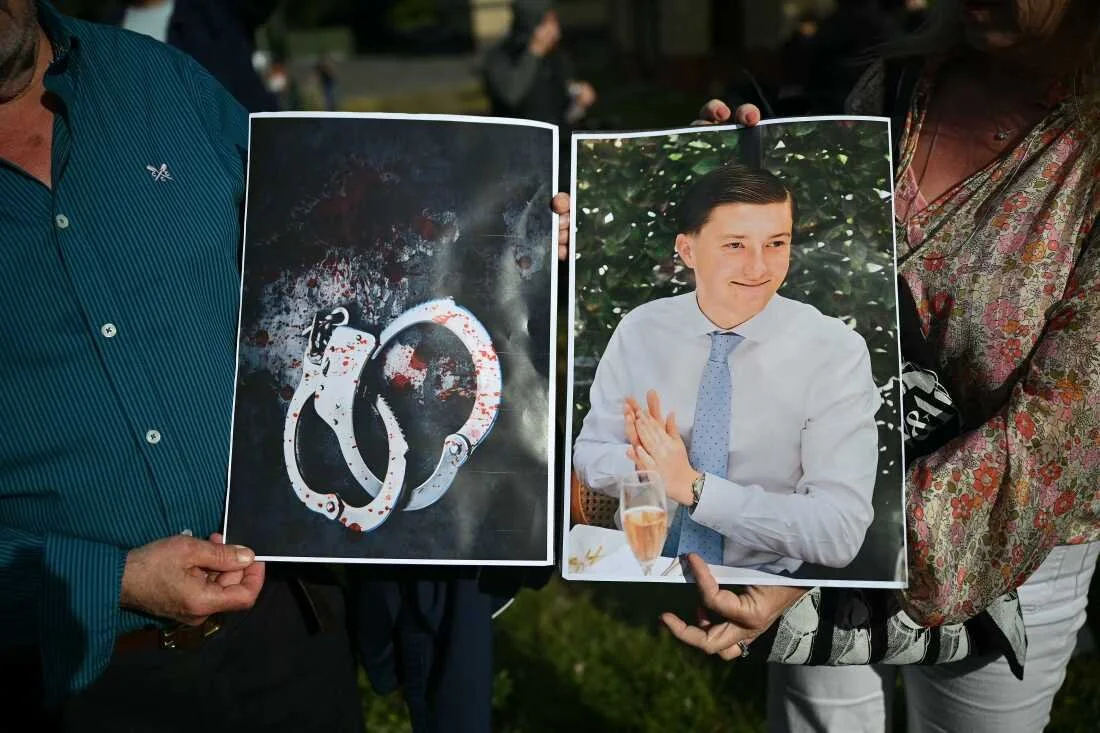
Henry Nowak (Photo: [NPR])
Starmer’s Selective Solidarity
At first glance, many might assume that Vickrum Digwa was an illegal immigrant or recent arrival. In reality, he was born and raised in Britain.
Prime Minister Keir Starmer, who took the knee in solidarity with George Floyd, has not staged any similar photo op to show solidarity with Henry Nowak or the citizens of his own country. He described the bodycam footage as “harrowing” and said he felt sick watching it as a father, while stating that it is important not to politicize a personal tragedy. Despite widespread public anger, no disciplinary action has been taken against the officers involved — one has resigned while the others remain in service — and Keir Starmer continues to deny the existence of two-tier policing in Britain.

Prime Minister Keir Starmer and deputy Labour leader Angela Rayner photo op after George Floyd’s death (Keir Starmer/Twitter)
Religious Exemptions and Two-Tier Policing
Since the 1950s, Britain has pursued a policy of mass immigration from South Asia and other regions while actively encouraging immigrant communities to retain their own religions, traditions, and cultural practices rather than requiring them to assimilate into British norms. This approach, often described as multiculturalism, allowed parallel societies to develop in which groups maintained distinct identities, values, and customs across generations.
One consequence of this policy is that Sikhs were granted a specific legal exemption to carry the kirpan — a bladed weapon — in public as a religious article. While ordinary British citizens are prohibited by law from carrying similar knives in public without a valid reason, this religious exception effectively creates two different sets of rules depending on a person’s faith.
In practice, this has produced a clear double standard. A British citizen who is not Sikh can be arrested for carrying a blade of the same size and type that a Sikh is legally permitted to carry. When that exemption is then used in the commission of a serious crime — as occurred when British-born Sikh Vickrum Digwa used his kirpan to murder 18-year-old Henry Nowak — the contradiction becomes impossible to ignore. The state’s decision to maintain religious carve-outs for weapons that are otherwise banned reflects a broader failure to enforce a single, consistent standard of law for all citizens, regardless of background or belief. This is a textbook example of two-tier policing: the law is applied differently depending on who you are.
The Cost of Rejecting Assimilation
When people immigrate to a country, it is essential that they assimilate into its culture, laws, and values. Assimilation does not mean erasing one’s heritage entirely, but it does require adopting the host nation’s legal system, language, and core social norms. Without this expectation, societies risk developing parallel communities that operate under different rules, leading to division, resentment, and unequal treatment under the law.
Countries that have historically demanded assimilation from newcomers — such as the United States in earlier periods or France’s traditional republican model — have generally experienced greater social cohesion than nations that encouraged immigrants to maintain separate identities indefinitely. Britain’s experience with multiculturalism has demonstrated the long-term costs of failing to require assimilation, as seen in the emergence of two-tier legal standards and the erosion of a shared national culture.
How America Abandoned Assimilation
For much of its history, the United States expected immigrants to assimilate into a shared national culture, often described as the “melting pot.” This expectation began to erode in the late 1960s, most notably with the Immigration and Nationality Act of 1965. The 1965 Immigration Act ended the national origins quota system that had prioritized European immigration and replaced it with a system that dramatically increased immigration from Latin America, Asia, and Africa. This fundamentally shifted the demographic and cultural character of the United States away from its historic Western European roots.
At the same time, America underwent a broader ideological shift away from assimilation and toward multiculturalism. Identity politics and group-based rights became increasingly prominent, while bilingual education programs were expanded in ways that often reduced pressure on immigrant children to learn English quickly. Over time, the older ideal of assimilation into a common Anglo-American culture was largely replaced by the idea of America as a “nation of immigrants,” where maintaining separate group identities was not only accepted but often encouraged. Slogans such as “Diversity is our strength” reflect this newer framework, emphasizing racial and ethnic diversity rather than shared values or cultural cohesion.
Where This Leads
If current trends continue without a return to meaningful assimilation requirements, Western countries risk losing the cultural foundation that made them successful in the first place — rule of law, individual rights, scientific rationalism, and limited government. These values are not automatically transmitted across generations or imported through immigration. Without deliberate effort to preserve and transmit them, they can erode.
While Western civilization has survived major challenges before, sustained demographic change combined with the active deconstruction of its cultural inheritance in schools, media, and institutions creates a trajectory that is difficult to reverse. The end result, if left unchecked, would not be a stronger or more vibrant civilization, but a fragmented one in which the unique achievements of the West — from individual liberty to technological progress — become diluted or lost.