Yuri Bezmenov 1983 Lecture
Foreword
Yuri Bezmenov, a former KGB operative who defected to the West in 1970, delivered one of the most sobering warnings of the 20th century in his 1980s lectures, interviews, and booklets. Speaking from direct experience in Soviet propaganda and ideological operations, he revealed how communist regimes sought not to conquer capitalist nations through military force, but to subvert them from within through a slow, methodical process of ideological subversion. His message was clear: the real battle is psychological and cultural, aimed at demoralizing a society until it can no longer defend its own values, institutions, or way of life.
In the lecture, Bezmenov outlines the four-stage framework used by the KGB and its allies: Demoralization (corrupting education, media, culture, and religion over 15–20 years to erode truth, morality, and critical thinking), Destabilization (weakening the economy, defense, and social cohesion), Crisis (triggering upheaval that exhausts the population), and Normalization (imposing a new order presented as inevitable while crushing dissent). He stressed that this strategy relies heavily on a society’s own citizens; academics, journalists, activists, and intellectuals, who unwittingly serve as agents of change.
Why This Matters for Americans Today
Decades later, Bezmenov’s analysis feels strikingly prescient. Many observers see echoes of these stages in contemporary American society, where deep divisions, institutional distrust, and cultural shifts have accelerated.
Demoralization is painfully evident in American education and culture, where civic knowledge has collapsed to alarming levels. Supreme Court Justice Neil Gorsuch has repeatedly warned that only a fraction of students are proficient in history and civics, with many Americans unable to name the three branches of government or pass a basic citizenship test.
This is no accident. Parents showing up at school board meetings to defend their children have been arrested and removed in handcuffs. Schools have hosted “drag queen story hours” for adolescents and placed explicit, pornographic books, featuring graphic depictions of sex acts, in K-12 libraries. Some governors and school districts have actively hidden from parents when their children are encouraged to identify as the opposite sex, including social transitions that can lead to irreversible medical interventions and surgeries.
Meanwhile, “defund the police” rhetoric from prominent politicians, media portrayals that paint law enforcement as villains and criminals as victims, and widespread teachings of “white privilege” that label people racist simply for the color of their skin have further eroded respect for authority and national cohesion. Critics of LGBTQ+ policies or aspects of Islam are routinely branded with new slurs like “transphobe” or “Islamophobe” effectively shutting down debate and labeling dissent as bigotry. Record numbers of Americans are on antidepressants or anxiety medication, youth suicide rates have risen dramatically over the past decade and a half (with particularly sharp increases among preteens and certain demographic groups), and generations raised without real-world experience lecture working entrepreneurs and business owners.
Bezmenov warned that demoralization would produce a society no longer able to think clearly, defend its values, or even recognize its own interests. The evidence in today’s America shows he understood exactly how this process works.
Destabilization is glaringly visible today in the extreme political and social polarization tearing at America’s fabric. Trust in institutions has collapsed, particularly in the mainstream media, which Yuri Bezmenov rightly described as unelected officials with a “license to rape our minds.” Far from neutral reporters, major outlets have become active propagandists, relentlessly pushing socialist and progressive ideologies that clash directly with traditional conservative American values. They promote “equity” over equal opportunity, champion expansive LGBTQ+ policies in schools and sports, enforce DEI mandates that prioritize identity over merit, and routinely label violent protests, complete with burning buildings, looting, and riots, as “mostly peaceful.” This deliberate distortion of reality, paired with economic pressures like runaway affordability crises, widening inequality debates, and labor disruptions from radical policy shifts and technology, has shattered shared truths and left society deeply fractured.
Bezmenov warned that once the media and cultural institutions are captured, destabilization accelerates rapidly. The America we see today powerfully validates his analysis.
Discussions of potential Crisis and Normalization arise amid intense cultural flashpoints, record mass illegal immigration, aggressive authoritarian measures during COVID, and the rising acceptance of socialism itself. Recent Gallup polling shows that 39% of Americans now hold a positive view of socialism (up from 36% in 2010), while among Democrats it has surged to 66% positive. Among young adults aged 18–29, support reaches 62% according to Cato/YouGov data. These trends, combined with ongoing debates over rapid societal changes, have led many to question whether foundational American values, freedom of speech, bodily autonomy, secure borders, and limited government, are being reframed as outdated or problematic in favor of a new imposed order.
During the Biden Administration, U.S. Customs and Border Protection recorded over 10 million encounters nationwide (with more than 8 million at the Southwest border), alongside an estimated 1.5–2 million “got-aways.” Policies were widely criticized for effectively tying the hands of Border Patrol agents through catch-and-release practices, reduced interior enforcement, and restrictions on detention and deportation.
The COVID-19 era dramatically illustrated crisis-level control and normalization tactics. Many of the hard lessons learned from the 1918 Spanish Flu pandemic, particularly regarding targeted protection of the vulnerable rather than broad societal shutdowns, were ignored. Officials and media promoted strict social distancing (the “6 feet apart” rule), lockdowns that shuttered “non-essential” businesses while allowing protests, and repeated public messaging about “the new normal” or “trust the science”, phrases that became ubiquitous. There was an aggressive push toward near-mandatory vaccination, with the unvaccinated facing strict travel restrictions, workplace mandates, and social exclusion. Prominent voices like Noam Chomsky called for isolating the unvaccinated from society, effectively suggesting they should not have access to basic services like grocery stores. Even years after the pandemic, protesters continue wearing masks, not for any public health reason, but to conceal their identities during demonstrations. In hindsight, it often appears the mask mandates’ most effective “public health protection” was enabling rioters and activists to hide their faces while engaging in criminal behavior with impunity.
Bezmenov warned that once a society reaches the Crisis stage, exhausted populations become willing to accept radical “solutions” that solidify Normalization. Recent American experiences offer a stark real-world test of his framework.
Speaking this plainly has itself become dangerous in today’s climate. Many Americans, whether consciously or not, now deploy postmodern deconstruction to dismantle every rational argument that challenges their ideological sacred cows. A detailed critique of identity politics or “woke” tropes is reflexively branded as “bigotry,” “racism,” or, in more honest terms, blasphemy against the new faith. Simply upholding conservative values as worthy societal goals is enough to mark someone as a target. In the mind of the true postmodern believer, words that contradict the prevailing orthodoxy are treated as literal violence.
Tragically, this rhetorical escalation crossed into actual violence with the September 2025 assassination of Charlie Kirk. While critics quickly invoked “live by the sword, die by the sword,” Kirk was killed not for wielding violence, but for the words he spoke in defense of his principles. His murderer answered free speech with the force of a communist’s bullet.
For first-time readers, Bezmenov’s lecture is not a partisan rant but a cold-eyed exposé of power through patience and infiltration. It challenges us to recognize when external ideologies, or their modern successors, exploit internal weaknesses. Whether one views current events as direct continuations of Soviet strategy or parallel patterns of subversion, his core warning remains urgent: a society that loses the ability to discern truth from propaganda, or to defend its foundational values, becomes vulnerable to transformation it never consciously chose. Reading it today offers a framework to understand our divisions and a call to rebuild moral, educational, and cultural resilience.
The following is an accurate, full transcript from Yuri Bezmenov’s 1983 Lecture: Ideological Subversion
Introduction to Subversion
Subversion is the term, if you look in a dictionary, or criminal codes to that matter, usually is explained as a part of activity to destroy things like [the] religion, government system, political economical system of a country. And usually, it’s linked to espionage and such romantic things as blowing up bridges, side tracking trains, cloak and dagger activity in [the] Hollywood style.
What I’m going to talk about now has absolutely nothing to do with the cliche of espionage or KGB activity of collecting information. So the greatest mistake or misconception, I think, is that whenever we are talking about KGB, for some strange reason, starting from Hollywood movie makers to professors of political science and quote-unquote “experts,” some on Soviet affairs or “Kremlinologists” as they call themselves, they think that the most desirable thing for Andropov and the whole KGB is to steal blueprints of some supersonic jet, bring it back to the Soviet Union and sell it to the Soviet military industrial complex. It’s only partly true.
If we take the whole time, money, and manpower that the Soviet Union, and KGB in particular, spends outside of USSR border we will discover, of course, there are no official statistics, unlike with the CIA or FBI, that espionage as such occupies only 10–15% of money, time and manpower. 15% of the activity of the KGB. The rest, 85%, is always subversion. And unlike a dictionary of English, Oxford Dictionary, subversion in Soviet terminology means always a destructive, aggressive activity aimed to destroy the country, nation or geographical area of your enemy.
So, there’s [sic] no romantics in there. Absolutely no blowing up bridges, no microfilms and Coca-Cola cans, nothing of that sort. No James Bond nonsense. Most of this activity is overt, legitimate, and easily observable if you give yourself time and trouble to observe it. But according to the law and law enforcement systems of the Western civilization, it’s not a crime! Exactly because of misconception; manipulation of terms. We think that [a] subverter is a person who is going to blow up our beautiful bridges. No! Subverter is a student who come[s] for exchange, a diplomat, an actor, an artist, a journalist like myself was ten years ago.
Sun Tzu & The Two-Way Street of Ideological Subversion
Now subversion is an activity which is a [sic] two-way traffic. You cannot subvert an enemy which doesn’t want to be subverted. If you know history of Japan for example, before the 20th century, Japan was a closed society. The moment a foreign boat comes to the shores of Japan, the Imperial Japanese army politely tell them to “get lost.” And if American salesman comes to the shore of Japan, I’d say 60 or 70 years from now back and says: “Oh, I have a very beautiful vacuum cleaner for you, you know, with good financing.” He says, “Please leave us. We don’t need your vacuum cleaner.” If they don’t leave, they shoot them to preserve their culture, ideology, traditions, values intact. You were not able to subvert Japan. You cannot subvert the Soviet Union because the borders are closed, the media is censored by the government, the population is controlled by the KGB and internal police. With all the beautiful glossy pictures of TIME magazine and Magazine America, which is published by the American embassy in Moscow, you cannot subvert Soviet citizens because the magazine never reaches Soviet citizens. It’s collected from the newsstands and thrown into [a] garbage can.
Subversion can be only successful when the initiator, the actor, the agent of subversion, has a responsive target. It’s a [sic] two-way traffic. [The] United States is a receptive target of subversion.
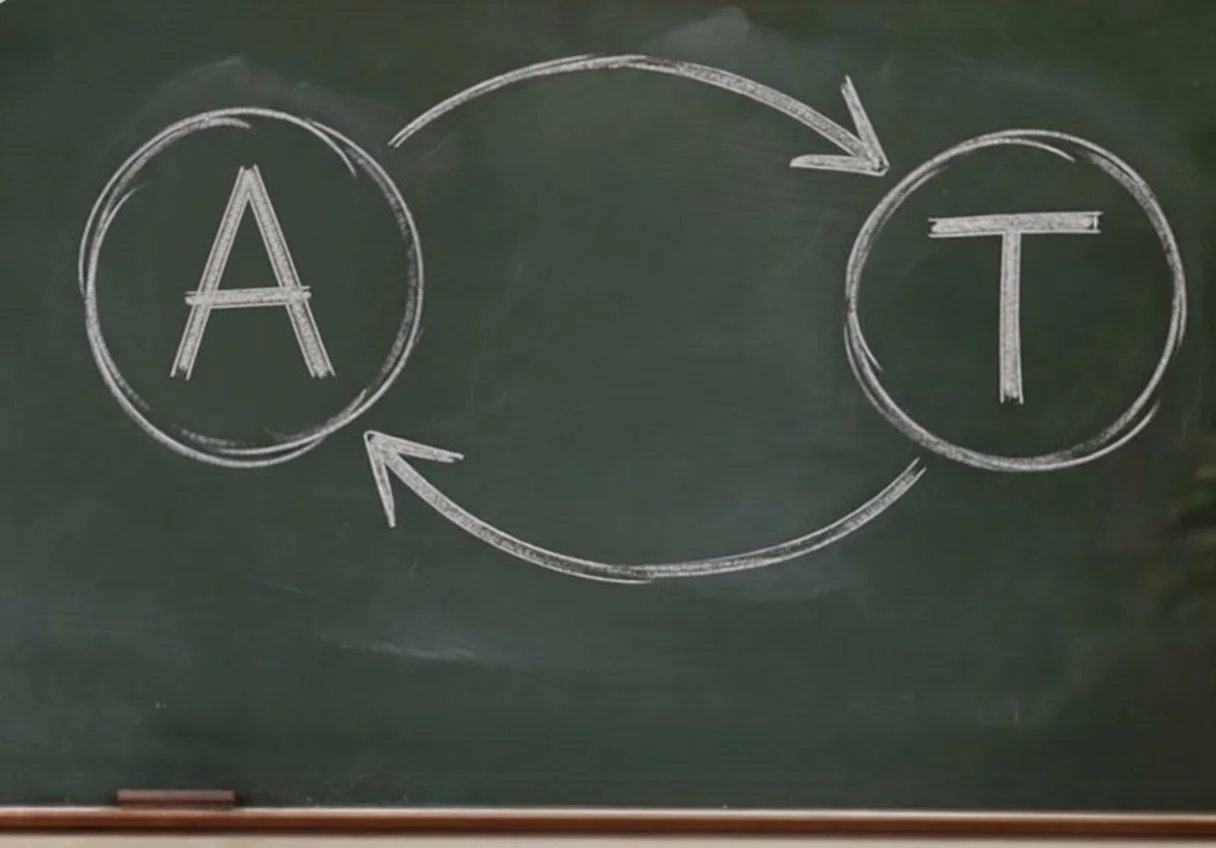
[Bezmenov drew an “A” to represent an agent of subversion (operatives, propagandists, or useful idiots pushing the process) and a “T” to represent the target (country or society) of subversion. The premise is that the target nation has to be responsive in order for the subversion to work, a society that is open, receptive, and willing (often unwittingly) to absorb and amplify the subversive influences. The key point is that subversion cannot succeed unilaterally.]
There is no response similar to that one from the United States to the Soviet Union. It stops halfway some way. It never reaches here.
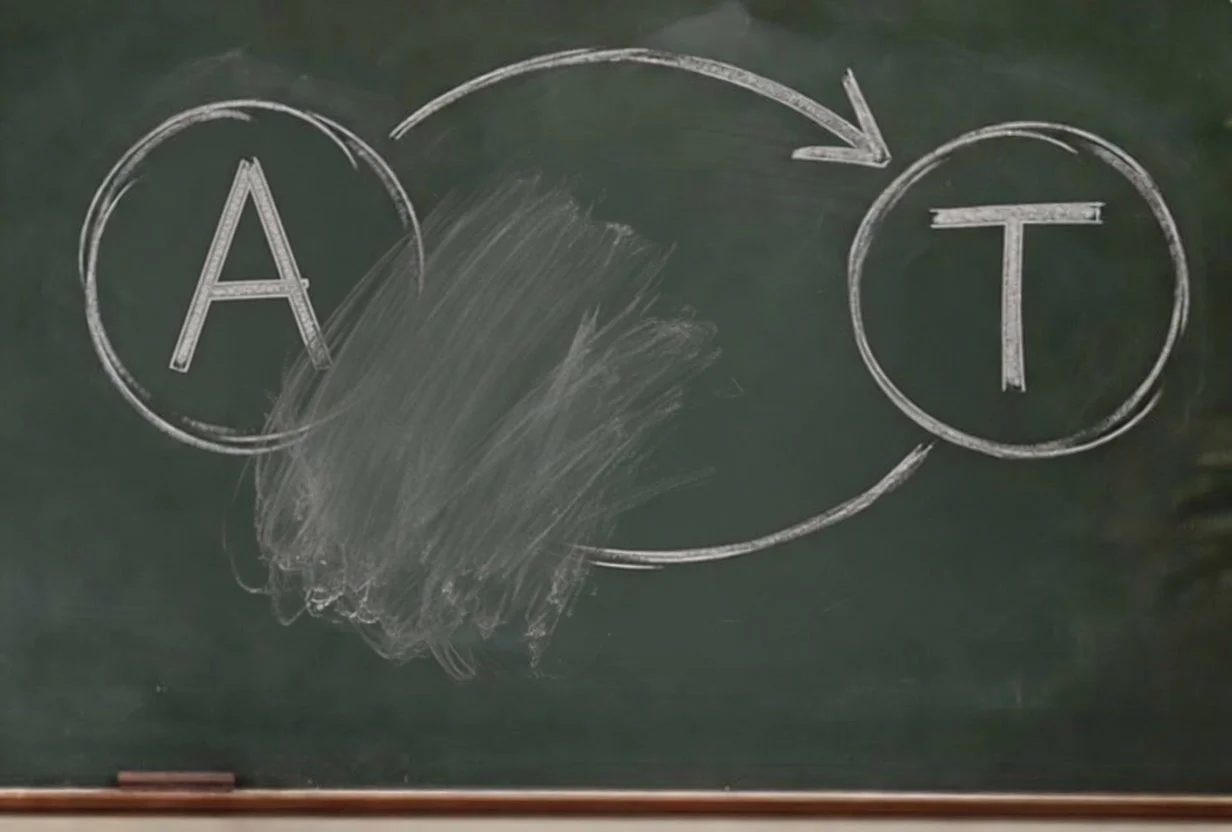
[Bezmenov explains that while ideological subversion is theoretically a two way street requiring a responsive target (the open society), in reality it is highly asymmetrical. E.g. the United States readily absorbs subversive influences from the agent (the Soviet Union), but any American response or counter-influence "stops halfway" and never reaches the subverter, because the closed Soviet system simply rejects and discards it. This highlights the one-sided vulnerability of open societies: they allow the flow in, while the subverter remains insulated and in control of the process. The subverter's closed system prevents meaningful reciprocal influence.]
The theory of subversion goes all the way back 2,500 years ago. The first human being who formulated the tactics of subversion was a Chinese philosopher by the name of Sun Tzu, 2500 years B.C. He was an adviser for several imperial courts in ancient China, and he said, after long meditation, that to implement state policy in a warlike manner is the most counterproductive, barbaric, and inefficient [way] to fight on the battlefield. You know that war is continuation of state policy, right? So, if you want successfully to [sic] implement your state policy and you start fighting, this is the most idiotic way to do it. The highest art of warfare is not to fight at all, but to subvert anything of value in the country of your enemy until such time that the perception of reality of your enemy is screwed up to such an extent that he does not perceive you as an enemy. And that your system, your civilization and your ambitions look to your enemy as an alternative, if not desirable than at least feasible. “Better red than dead.” That’s the ultimate purpose, the final stage of subversion after which you can simply take your enemy without a single shot being fired, if subversion is successful. This is basically what subversion is. As you see not a single mention of blowing up bridges. Of course, Sun Tzu didn’t know about blowing up bridges, maybe there were not that many bridges at that time.
But the basics of subversion is being taught to every student of KGB school in USSR and to officers of military academies. I’m not sure if the same author is included in the list of reading for American officers, to say nothing about ordinary students of political science. I had difficulty to find the translation of Sun Tzu in the library of a university in Toronto, and later on, here in Los Angeles. But it’s a book which is not available; it is forced to every student in USSR. Every student who is taught to be dealing further in his future career with foreigners.
The Four Stages of Ideological Subversion
1 - Demoralization
What subversion is, basically it consists of four periods timewise. If we start from here and go this way [gesturing from top down]; time, right, this is the beginning point. The first stage of subversion is the process, which is called basically demoralization. It says for itself what it is. It takes from say 15 to 20 years to demoralize a society. Why 15 or 20 years? This is the time sufficient to educate one generation of students or children, one generation, one lifetime span of a person, a human being which is dedicated to study, to shaping up the outlook, ideology, personality, no more, no less. Usually, it takes from 15 to 20 years. What it includes? It includes influencing by various methods (infiltration, propaganda methods, direct contacts, doesn’t really matter I will describe them later) of various areas where public opinion is formulated or shaped: Religion, educational system, social life, administration, law enforcement system, military (of course), and labor and employer relations, economy. Okay? Five areas. I will not write them down because we’ll not have enough space.
Sometimes when I describe all the methods, students ask me [the] question: “Are you sure this is the result of the Soviet influence?” Not necessarily. You see the tactic of subversion about which I’m talking [about] is similar to the martial art, the Japanese martial art. If some of you [are] familiar with that tactic, probably you will remember that if an enemy is bigger and heavier than yourself, it would be very painful to resist his direct strike. If a heavier person wants to strike me in the face, it would be very naive and counterproductive to stop his blow. The Chinese and Japanese judo art tells us what to do. First, to avoid the strike. Then, to grab the fist and continue his movement in the direction where it was before, right? Until the enemy crashes in[to] the wall. You, see? So, what happens here? The target country obviously does something wrong. If it’s a free, democratic society, there are many different movements within the society. There are obviously in every society, there are people who are against the society. They may be simple criminals, ideologically in disagreement with the state policy, conscientious enemies, simply psychotic personalities who are against anything. Right? And finally, there is [a] small group of agents of a foreign nation; bought, subverted, recruited… right? The moment all these movements will be directed in one direction. Right? This is the time to catch that movement and to continue it until the movement forces the whole society into collapse, into crisis. Right? So that’s exactly the martial art tactic. We don’t stop an enemy, we let him go, we help him to go in the direction we want them to go.
So, on the stage of demoralization, obviously, there are tendencies in each society, in each country, which are going to [sic][in the] opposite direction from the basic moral values and principles. To take advantage of these movements, to capitalize on them, is the main purpose of the originator of subversion. So, we have religion, we have education, we have social life, we have power structure, we have labor relations, unions, and finally we have law and order. One, two, three, four, five, six. Okay, these are the areas of application of subversion. What it means exactly in [the] case of religion: destroy it, ridicule it, replace it with various sects, cults which bring people’s attention, faith whether it is naive, primitive, doesn’t really matter. As long as the basically accepted religious dogma is being slowly eroded and taken away from the supreme purpose of religion, to keep people in touch with the supreme being, that serves the purpose. Therefore, replace accepted, respected religious organizations with fake organizations. Distract people[’s] attention from the real faith and attract them through various different faith[s].
Education
Distract them from learning something which is constructive, pragmatic, efficient. Instead of mathematics, physics, foreign languages, chemistry, teach them history of urban warfare, natural foods, home economy, your sexuality, anything as long as it takes you away. Okay?
Social Life
Replace traditionally established institutions and organizations with fake organizations. Take away the initiative from people. Take away responsibility from naturally established links between individuals, groups of individuals, and society at large, and replace them with artificially, bureaucratically controlled bodies. Instead of social life and friendship between neighbors, establish social workers institutions. A people who are on [the] payroll of whom? Society? No, bureaucracy. The main concern of social workers is not your family, not you, not social relations between groups of people. The main concern is to get the paycheck from the government. What will be the result of their social work doesn’t really matter. They can develop all kinds of concepts to show to the government and to the people that they are useful. Okay. Away from the natural links.
Power Structure
Okay. The natural bodies of administration, which are traditionally either elected by people at large or appointed by elected leaders of society, are being actively substituted by artificial bodies. The bodies of people, groups of people who nobody elected, never, as a matter of fact, most of the people don’t like them at all, and yet they exist. One of such group[s] is media. Who elected them? How come they have so much power? Almost monopolistic power on your mind. They can rape your mind. But who elected them? How come they have the nerve to decide what is good and what is bad for the elected by you; president and his administration. Who the hell are they? Spiro Agnew [39th VP of USA], who is hated by the liberal left, called them a bunch of enfeebled snobs, and that’s exactly what they are [actual quote: "an effete corps of impudent snobs"]. They think they know… they don’t.
The level of mediocracy in a big establishment like New York Times, Los Angeles Times, [any] major television network, you don’t have to be [an] excellent journalist. You have to be exactly a mediocre journalist. That’s easier to survive. There’s no competition anymore. You have your good nice income; one hundred thousand dollars a year. That’s it. Whether you are better or worse [it] doesn’t really matter anymore. As long as you are smiling for the camera and do your job. That’s it. No more competition. Power structure slowly is eroded by the bodies and groups of people who do not have neither qualification[s] nor the will of the people to keep them in power, and yet they do have power.
Together with that, there is another process…
Law Enforcement
Law and order organization and structure is being eroded. For the last 20, 25 years, if you see old movies and new movies, you can see that in new movies a policeman, an officer of the United States Army looks dumb, angry, psychotic, paranoid. A criminal looks nice, kind of: “Well, he smokes hash and shoots the whatever drug, but basically, he’s a nice human being.” “He’s creative and he’s unproductive only because society oppresses him.” Whereby [sic] a general of [the] Pentagon is always by definition: “dumb,” “a war maniac.” A policeman is a “pig,” “a rude policeman.” “He abuses his power.” You know? A generalization like that. The hatred, the mistrust to the people who [are] supposed to protect you and enforce law and order. Moral relativity. The Angelo Buono process lasted two years in Los Angeles and yet there are still some lawyers who say: “Look, he’s a nice character.” As a matter of fact, there was some witness, also a criminal, who said: “Well, he’s a nice guy. I asked him one day to burn a house of my enemy and he wouldn’t do it. He’s a nice fellow.” Allusion; a slow substitution of basic moral principles whereby a criminal is not a criminal actually. He’s a defendant even if his guilt is proven, there is still a doubt. To kill or not to kill, to be or not to be. Thou shall not kill, yes. But this line may not necessarily be applicable to a murder. Thou shall not murder. That should be the presumption, not that thou shall not kill. Okay.
Labor Relations
At this stage, within 15–20 years, we destroy the traditionally established links of bargaining between employer and employee [with] the classical Marxist–Leninist theory of natural exchange of goods. ‘Person A’ has five sacks of grain and ‘person B’ has five pairs of shoes. The natural exchange without money is when they bargain between each other. And only with the introduction of the third ‘Force C,’ an entirely third, foreign stranger who says: “No, don’t give him five sacks of grain, give it to me, and you give me your five pairs of shoes and I will distribute it accordingly so that the economy will go.” This is the death of natural exchange, the death of natural bargaining.
Well… trade unions were established a hundred years ago. The objective was to improve working conditions and to protect the rights of workers from those employers who were abusing their right[s] because they had more money. Objectively at that time, initially, the trade union movement did work. What we see now is that the bargaining process is no longer resulting in the compromise which is leading objectively to [the] betterment of working conditions and increase of salary. What we see is that after each prolonged strike, the workers lose even if they have 10% increase of their salaries. They cannot catch up due to inflation and due to missed time. More than that, millions of people suffer from that strike because [the] economy now is interdependent. It’s intertwined like one body. Previously, steel workers, say a hundred years ago, could strike and nobody would suffer. Now, it’s impossible anymore. If a garbage collector strikes today, the rest of the multimillion city is stinking. I mean, there is no more service. In Quebec, for example, we had the electricians who were on strike in the middle of winter. You can freeze your bottom and they still were on strike. Did they catch up with the salary? No, they lost. Who benefited? The leaders of [the] trade unions. What is the motivation for [a] strike? Improving a worker’s condition? No. Obviously, it’s not. Then what is it? Ideology. To prove to these capitalists and the obedient horde of workers like sheep, all of these people. And they cannot disobey. Why? Because if they do, you know what happens to them? Pickets, murders, shooting truck drivers by picketers. In Montreal, for example, I saw with my own eyes when I was a correspondent of CBC International, Canadian Broadcasting Corporation, when the workers of aircraft factory destroyed computers and the equipment in the factory. And the administration employed strike breakers. Their cars were turned upside down and burned. Their houses were burned. Their kids were intimidated. And some victims were there, of that we can be sure. Why? To improve conditions of worker? No. Ideology. Okay, so… this is what happens basically.
It may or may not happen without the help of the Soviet Union, but the natural tendencies are being greatly taken advantage of and capitalized [on] by the Soviet propaganda systems. How? Whenever [a] trade union strikes, we have [an] influx of propaganda, mass media, ideological dissemination, the “worker’s right[s].” And we repeat it like parrots. “Yes, worker’s rights.” Whose rights? Workers? No, the only freedom of [a] worker, to sell his labor according to his own desire and will, is taken away from him. By whom? By [a] trade union boss. Unlimited power is given responsibility. “I want to sell my labor not for $2.50 an hour, but for $2.” I don’t have [the] right. My freedom is denied to me. I know that if I sell my work for $2.00 an hour, not for $3.00 an hour, I will compete better with the other guy who is lazy and more greedy. I don’t need three dollars, I need only two dollars. No. I was made to believe by media, by business, by advertising agencies that I need more and more and more. Have you ever heard any advertising on TV to consume less? No. No way. Whether you need a six-cylinder car or not, you have to buy it, and hurry up. When I was driving here on the local radio station, an excited announcer said, “You, hurry up. Rush and save, save, save! There’s a pantyhose sale!” Save… by buying more. See?
Of course, of course, it would be too naive to expect the KGB makes that advertising agency to do such a crazy commercial. No, of course not. But what we did when I was working for Novosti Press Agency, we would snowplow editorial offices, student organizations, religious groups with literature of class struggle. If not directly Marxist–Leninist propaganda, then propaganda of legitimate aspirations of [the] working class: betterment of life, equality. Equality, mind you.
Equality Under Communism
President Kennedy once said, “We will make America believe that people are born equal.” Are people born equal? Is there any mentioning [sic] in the Bible or any other holy scripture in any religion, any religion, if you don’t believe me go to the library and check it, there is not a single word about equality. Just the opposite. By your deeds, God will judge you. What you do is important, the merit of your personality. You cannot legislate equality. If you want to be equal, you have to be equal, you have to deserve it. And yet we build our society on the principle of equality. We say “people are equal.” We know it is false. It’s a lie. Some people are tall and stupid. Others are short, bald, and clever. Stop… [interrupted by laughter and applause]
If we make them equal by force, if we put the principle of equality in the basis of our social political structure, it’s the same thing as building a house on sand. Sooner or later, it will collapse. And that’s exactly what happens. And we as Soviet propaganda makers are trying to push you in the direction which you go yourself. “Equality, yes, equality. People are equal. Land of equal opportunities.” Is it true or not? Think about it. Equal opportunities, should there be equal opportunity for me and for a lazy bastard to come here from some other country and immediately registers as a welfare recipient [for] benefits? I never received a single — sorry, I did receive once — but I never applied for welfare. For thirteen years I took any job. Security guard, journalist, taxi driver, anything. Well, I was restless but some people don’t like it. They admit it. So why should we be? Why should we have equal opportunities? Why?
Woman from the audience answers his question attempting to clarify for him: “The equal opportunity to excel.” Which is closer to what the founding Fathers intended by the phrase.
Equal opportunity in equal circumstances, yes. But we know people are different. To excel, yes. Provided we reach the same level of excellency, perfection, which is [a] hypothetical distant future. Yes, maybe. But we know perfectly well that even with the best intentions, people could not be equal. Why should we have equality in the say… legal system; myself, I’m considering myself a law-abiding citizen, and a person who comes here to rob and shoot?
The United States administration under Carter imported thousands of Cuban criminals. They were known criminals, yet they were accepted. Do you think it’s fair if myself and my wife from Philippines who work like, excuse me, whores as a lab technician in the hospital should have the same rights as a criminal came from Cuba? Why?
And yet we repeat as parrots: “Equality, equality, equality.” And the Soviet propaganda system helps us to believe that equality is something which is desirable. Democracy, as it was established by fathers of this country, of this system in the last century, is not equality. It is the system where different people, unequal people, have a chance to survive and help each other in constant competition and constant perfection. Not in equality, which is superimposed from a godfather or nice person in Washington, D.C. And the absolute equality exists in Soviet Union, quote-unquote “equality.” Everybody’s equal in dirt. Except some people are more equal than the others in politburo.
So, the moment you bring a country to the point of almost total demoralization, when nothing works anymore, when you are not sure what is right or wrong, good and bad, where there is no division between evil and good, when even the leaders of church sometimes say, “Well… violence for the sake of justice, especially social justice, is justified in countries like Nicaragua, El Salvador, well… maybe Rhodesia.” And we listen to them and say: “Yeah, probably it’s true.” Is it true? No, it is not true. Violence is not justified, especially for the sake of quote-unquote “social justice” introduced by Marxist–Leninists, that is my former colleagues from Novosti Press Agency. Okay, so we reached that point.
2 - Destabilization
The next step is destabilization. Again, this word says for itself what it is. To destabilize all the relations, all the accepted institutions and organizations in the country of your enemy. How do you do it? You don’t have to send a battalion of KGB agents to blow up bridges. No, you let them do it themselves. The area of application is, again, it’s narrower now. Not like the previous case. The overt, legitimate actions of the of the KGB in this case would be hardly noticeable. There is no crime if a professor who recently went to USSR introduces a course of Marxist–Leninism in a Californian college, for example. Nobody is going to come to his doorstep and say, “Okay, mister, come. You are under arrest.” No, it’s not a crime. It’s not even considered a moral crime against your country. So, the area of application here is narrowing down to economy, again labor relations, to law and order plus military, and again, the media, but [in a] wider scope. A little bit different, I’ll explain later. OK, basically three areas.
Economy; the radicalization of [the] bargaining process. If on that stage we still could achieve theoretically some positive compromise between the negotiating sides with, say, introduction of arbitrary judges, a third side objectively judging the demands of both sides. Here, it’s radicalization. On the stage of destabilization, we cannot come to [a] compromise even within a family. The husband and wife couldn’t figure out which is better: [the] husband wants his kids to eat at the table and [the] wife wants the child to roam around the room and drop food all over the floor. They cannot come to compromise unless they start a fight. It’s impossible to reach a compromise, [a] constructive compromise, between neighbors. Some people say, “I don’t like you to [sic] watering your lawn at that time because exactly at that time I’m walking my dog and he’s getting nervous that he cannot pass his bowels.” They cannot compromise, they go to a civil court or something like that. Radicalization of human relations. No more compromise. Fight, fight, fight.
The normal, traditionally accepted relations are destabilized. The relations between teachers and students in schools and colleges. Fight. The relations between an economical [sic] sphere between laborers and employers are further radicalized. No more acceptance of the legitimacy of [the] demands of workers. Unlike Japanese, with Nemawashi, if you ever heard about it, when the workers are involved in the decision-making process, therefore they don’t have moral incentive to fight their bosses. In United States it’s just the opposite; the harder is [sic] the fight, the better. The more heroic they look. When the Greyhound network was on strike recently, the correspondence of local TV networks all over the United States were approaching the strikers and they say, “Oh, yes, we are doing something nice.” They looked like heroes and they were proud. There was some family, the husband was a bus driver. Now they decided in the protest against the bosses to camp somewhere in the forest. And they were presented to the audience as a heroic, nice people. You, see? The violent clashes between passengers, picketers, and the strikers are presented as something normal.
Ten, fifteen, twenty years ago, we would be angry. We would say “Why? Why? Why so much hatred?” Today, we are not. We say “Well, it’s commonplace.” Radicalization, militarization sometimes, as I explained on that stage [points to “Demoralization”], I took a step little bit further. Shooting people. Okay.
Law and order now, also is pushed into the area where previously people settle their differences peacefully and legitimately. Now, we are getting court cases, in the smallest irrelevant cases, we cannot solve our problems anymore. The society at large becomes more and more antagonistic between individuals, between groups of individuals, and the society at large. The media puts himself in the opposition to the society in general at large. Separate, alienated, on that stage… [points to “Destabilization”]. You remember I was talking a couple of hours ago about the sleepers? That’s when the students from, say, [the] United States, if they are trained in Lumumba University or developing nations, that’s the students I was dealing with, are being sent back from the Soviet Union [to] here. Or if they were already in the United States, in the country which is an object of subversion, they spring to action. The sleepers go up. They slept for 15 to 20 years. Now they become leaders of groups, preachers, I don’t know, public figures prominently. They actively include themselves in the political process. All of a sudden, we see a homosexual. Fifteen years ago, he did his dirty job and nobody cared. Now he makes it a political issue. He demands recognition, respect, human rights, and he rallies a large group of people, and there are violent clashes between him and police, his group and ordinary people, no matter what. It’s black against white, yellows against green. [It] doesn’t matter where the division line goes. As long as these groups come into antagonistic clash, sometimes militantly, sometimes with firearms, that is [the] destabilization process. The sleepers, many of whom are simply KGB agents, become leaders of the process of destabilization. Doesn’t mean that Comrade Andropov sends Comrade Ivanov to the United States. The person who takes care is already here. He’s a respected citizen of the United States. Sometimes he gets money from various foundations for his legitimate struggle for, I don’t know, human rights, women’s rights, kid lib, prison lib, whatever. There are sympathetic Americans who donate their money to him.
3 - Crisis
Destabilization process usually leads directly to the process of crisis. In [the] case of developing nations, this is the area where I was active. The process starts when the legitimate bodies of power, the social structure collapse; it cannot function anymore. So instead, we have artificial bodies injected into society such as non-elected committees. You remember I was talking about them here [points to “Demoralization”]. Social workers who are not elected by people, media who are self-appointed rulers of your opinion, some strange groups which claim that they know how to lead society forward. They don’t, usually. All they care [about] is how to collect donations and sell their own concocted ideology; [a] mixture of religion and ideology. Here we have all these artificial bodies claiming power. If the power is denied to them, they take it by force. In [the] case of Iran, for example, all of a sudden, we have revolutionary committees. Who and what kind of revolution? There was no revolution here, and yet they had the committees. They were taking power of judgment. They had the power of execution, they had the power of legislation, and they had the power of judicial. All of them combined in one person who is half-baked intellectual, sometimes graduated from Harvard University or Berkeley. He comes back to his country and then he thinks that he knows the answer[s] to all the social economical [sic] problems. Okay.
Crisis is when society cannot function any more productively; it collapses. Obviously, that’s the word for crisis. So therefore, the population at large is looking for a savior. The religious groups are expecting a messiah to come. The workers say “We have family to feed.” Let’s have a strong government, maybe a socialist government, centralized, where somebody will put the employers in their place and let us work. We are sick and tired of going to strike and missing overtime and all that stuff. We need some strong man, strong government. A leader, a savior is needed. [The] population is sick and tired already. And here we are. We have a savior. Either a foreign nation comes in or the local group of leftists, Marxists, no matter what they call themselves; Sandinistas, a reverend of some sort, Bishop Muzorewa like in Zimbabwe. Doesn’t matter. A savior comes and says, “I will lead you.”
So, we have two alternatives here: civil war and invasion.
See how it goes? Civil war, we know what it is. Lebanon is the best example. The civil war, which was artificially implanted in Lebanon by injection of force of PLO, Palestinian Liberation Organization. Invasion we had in many other countries like Afghanistan, and name any East European country, it was invaded by the Soviet army. But the result is the same: the next stage is normalization.
4 - Normalization
Normalization is a very ironic word, of course. It is borrowed from [the] 1968 situation in Czechoslovakia when the Soviet propaganda, and after them the New York Times, declared “the country is normalized.” The tanks moved into Prague, so there is no more Prague Spring, there is no more violence. Normal. Normalization.
At that stage, the self-appointed rulers of the society don’t need any revolution anymore. They don’t need any radicalism anymore. So, this is the reverse from destabilization. Basically, it is stabilizing the country by force. So, all the sleepers, and activists, and social workers, and liberals, and homosexuals, and professors, and Marxists, and Leninists are being eliminated, physically sometimes. They’ve done their job already. They’re not needed anymore. The new rulers need stability to exploit the nation, to exploit the country, to take advantages [sic] of the victory. Okay? So, “no more revolutionaries, please.” And that’s exactly what happened in a number of countries. You remember Bangladesh? This is the crisis in which I was instrumental. First, they had Mujibur Rahman. In 1971, he was the leader of People’s Party; Awami League. With mustache like Stalin, he was in Russia many times. In five years, he was shot by his former colleagues, Marxists. He fulfilled his function. In Afghanistan, it happened three times. First there was Taraki, then there was Amin, now there is Babrak Karmal. They killed each other successively, one after another, the moment he fulfills his duty. The first one demoralized [the] country, the second destabilized, the third one brought it to crisis. Goodbye comrades. Babrak Karmal comes from Moscow and [they] put him into the seat of power. The same thing happened in Granada recently. Maurice Bishop, [a] Marxist, was killed by Austin, what’s his name? General something [General Hudson Austin], who was also a Marxist. Right? So “no more revolutions, please. Normalization now.” From now on, no more strikes, no more homosexuals, no more women[’s] lib, no more kid lib. No more lib period. Good, solid, democratic proletarian freedom. That’s it.
How to Stop/Reverse This Psychological Warfare
Now, to reverse this process takes enormous effort. When today, [the] United States had to invade Grenada to reverse the process of subversion. Some people say, “Boy, this is not good. It’s not kosher to invade the beautiful country, island of Grenada.” Well, why didn’t you stop the process here [points to “Demoralization” on chalkboard] when Grenada was just approached by leftists? Why not to [sic] prevent Maurice Bishop to come in power in the first place? Did Grenadians want him? Very questionable. They didn’t know who was Maurice Bishop in the first place. He came to power by coup d’etat himself. Okay? No. We let the situation develop further and further and further until the crisis, and normalization very soon, and then the United States decided to invade [the] country, discovering that the country was absolutely a military base for the Soviet Union. Of course it’s a drastic measure, of course it’s a pity that [the] Marine Corps had to lose what, seventeen lives? Very bad. Why not stop the process before it comes to crisis? Oh no, intellectuals will not let you. It’s interference into domestic affairs. They’re very careful not to let American administration to interfere in domestic affairs of Latin American countries. They don’t mind [the] Soviet Union interfering in these affairs.
So, to reverse this process from here [points to “Normalization” on chalkboard] it takes only and always military force. No other force on Earth can reverse this process at this point. At this point [points to “Crisis” on chalkboard], it does not take military invasion of the United States Army. It takes strong action like in Chile. A CIA covert involvement to prevent the savior from outside to come into power, and to stabilize [the] country before it erupts into civil war. Support the right wing conservative forces by money, by crook, so love doesn’t matter. Stabilize the country. Don’t let the crisis develop into civil war or invasion. “Oh, no,” your liberals will say, “it’s against the law!” The Congress will not appropriate money for covert actions of [the] CIA. Why not? Should we wait until the normalization come[s] and Soviet tanks land in Los Angeles airport? Now, at that point, at the point of destabilization, also the process could be reversed. Again, easier than this. No CIA involvement at this point. You know what it takes here? Restriction of some liberties for small groups, which are self-declared enemies of the society. As simple as that. “Oh no,” the media and liberals will tell you, “This is against the American constitution. How can we, by force, deny the civil rights to criminals?” For example. “It’s not good.” So, we allow them to. Okay, if you allow the criminals to have civil rights, go on, and bring the country to the crisis. This is a bloodless way to do [it]: curb their rights. I mean, not to put them in prison. No, no. I’m not talking about putting all the gays from San Francisco in a concentration camp. Do not allow them to take political force.
Do not elect them to the seats of power. Whether it is municipality level, state level, or federal level, it has to be beaten in the heads of American voters that a person like that in a seat of power is an enemy. Do not be afraid of this word. It is an enemy. If he is not an enemy here [points to “Destabilization”], he will be here [points to “Crisis”]. Later on, he will be shot, of course [points to “Normalization”]. But at this point [points to “Destabilization”], he is an enemy.
You’re doing [a] great service by denying him a right to capitalize on his own crazy ideas and become a powerful man; a man who uses the seat of power. Restriction of certain freedoms and permissiveness at that point would prevent sliding into crisis and probably will return the process of destabilization. To curb unlimited power, monopolistic power of trade unions here [points to Destabilization”], at that point, would save [the] economy from collapsing.
To introduce a law to stop private companies of raping public opinions, minds, in the direction of consumerism. No company must have a right to force you into buying more unless you want it. There must be a law. You want to advertise your car? Okay, but not a single mentioning of buying it now and saving money. It must be against the law to force people to consume more. Self-restraint previously, before this process started, the self-restraint was a business of church, religion, because our preachers, the fathers of church, would tell us material values are good, but it’s not the prime function of [a] human being because you have to live with something… Obviously, the design for our life is not to consume more deodorants. There must be something greater. If such a complicated instrument as [a] human body was created, obviously there must be some higher purpose for that.
And it’s very easy to avoid destabilization by denying the greedy companies one little freedom, one little liberty, forcing you into turning yourself into processors of unwanted products and goods. They turn you into machines, like the worm; there’s inlet and outlet. How long [does] an average appliance last these days? Less than a year. Why? Where’s workmanship? We want you to buy more.
Destabilization process could be easily overcome if, as I say, the society, by its own will or after persuasion by the leaders, will come to the idea of self-restraint. It’s so hard, we want to consume more, but you have to unless you will come to this stage [points to “Normalization”] when, as we say in Russia, “If [the] Sahara Desert ever becomes a communist state, there will be a shortage of sand.” So, you have to curb your expectations at this point [points to “Destabilization”] before it’s too late. But no, we don’t want to do it.
Demoralization process, again, it’s the easiest thing to reverse. First of all, by restricting import of propaganda, the easiest thing to do. Unlimited, unrestrained import of Soviet literature, Soviet journalists, giving Soviet propaganda and ideological agitators equal time on American TV network. It has to be stopped. And it’s easy. They wouldn’t, they won’t be offended mind you. As a matter of fact, they will respect America more. But then my former colleague, Vladimir Pozner appears on Nightline and Ted Koppel asks him, “Well, Vladimir, what do you think about this?” And what can he think? He is an instrument of propaganda; he thinks what Comrade Andropov tells him to think. He’s just a nice, articulate mouthpiece of the Soviet subversion system. And Ted Koppel makes you believe that my friend, Vladimir Pozner thinks?!
The process of demoralization may not have started at all if at that point [points to “Demoralization”]the country which is a recipient of subversion actively, not violently but actively, prevents importation of foreign ideology. I don’t want America to follow the pattern of ancient Japan. You don’t have to shoot every foreigner when it approaches the sacred borders of the United States. But when he offers you a [sic] junk in the disguise of a very shiny something, you have to tell him, “No, we have our own junk.” If at that point, the society is strong, brave, and conscientious enough to stop importation of ideas which are foreign, then the whole chain of events could be prevented.
Recently, I’ve been to [the] Philippines and I was shocked how in big cities like Manila, children listen to deafening music. A melodious nation with long traditions of good, nice ethnic music introduced by Spanish long time ago, maybe two centuries, three centuries ago, I don’t remember how long, all of a sudden listened to musical garbage blasting their radios at full blast, at full volume. Why?
In India, I spent many years watching the reactions of Indians walking out of movie theaters after seeing Hollywood productions. They couldn’t figure out why Americans are so wasteful, they smashed their cars, their shiny cars, every five minutes. How come they shoot each other for half [a] million dollars? Is it true that they’re so obsessed with sex? Can you imagine showing a movie where each five minutes there is copulation on the screen to a country like India with long traditions of respect to this private matter, or to Pakistan?
And [the] United States expects these people to respect you? No way. Oh yes, they will see the movie. They’ll pay five rupees to see that garbage. But they walk out and will tell their kids, don’t respect Americans. Don’t be like Americans. See?
So, the process of demoralization could be stopped right here [points to before “Demoralization”], both as an export and as an import. And that takes one step, one very important thing to do. You don’t have to expel all the KGB agents from Washington, D.C. The most difficult and at the same time the simplest answer to the subversion is to start it here and even before by bringing back the society to religion, something that you cannot touch and eat and put on yourself, but something that rules society and makes it move and preserve[s] it.
A Soviet scientist, [Igor] Shafarevich, who has nothing to do with religion he is a computer scientist, did a [sic] very intensive research on the history of socialist countries. He called socialist or communist any country with a centralized economy and a pyramidal style of power structure. And he discovered, actually he didn’t discover it he just brought to [the] attention of his readers, that civilizations like Mohenjo-daro, in the River Indus area, like Egypt, like Maya, Incas, like Babylonia culture collapsed and disappeared from [the] surface of [the] Earth the moment they lost religion. As simple as that. They disintegrated. Nobody remembers about them anymore. Well, distantly.
So the ideas are moving society and keeping mankind as a society of human beings. Intelligent, moral agents of God. The facts, the truth, the exact knowledge may not. All this sophisticated technology and computers will not prevent society from disintegrating and eventually dying out. Have you ever met a person who would sacrifice his life, freedom, for the truth like that? [Writes 2x2=4 and gestures to it] This is truth. I’ve never met a person who said “This is truth and I’m ready too, shoot me, to defend the truth.” Right? But millions sacrifice their life, freedom, comfort, everything for things like God, like Jesus Christ. It’s an honor. Some martyrs in the Soviet concentration camp[s] died, and they died in peace, unlike those who shouted “long live Stalin!” Knowing perfectly well that they may not live long. Something which is not material moves society and helps it to survive. And the other way around, the moment we turn into “two by two is four” and make it the guiding principle of our life, our existence, we die. Even though this is true and this [points to “God”] we cannot prove. We only can feel and have faith in it.
So the answer to ideological subversion, strangely enough, is very simple. You don’t have to shoot people, you don’t have to aim missiles, Pershings and cruise missiles at Andropov’s headquarters. You simply have to have faith and prevent subversion. In other words, not to be a victim of subversion, don’t try to be a person who in judo is trying to smash your enemy and being caught by your hand. Don’t strike like that, strike with the power of your spirit and moral superiority. If you don’t have that power, it’s high time to develop it. And that’s the only answer. That’s it.
Listen to his booklet audiobook “Love Letter to America”